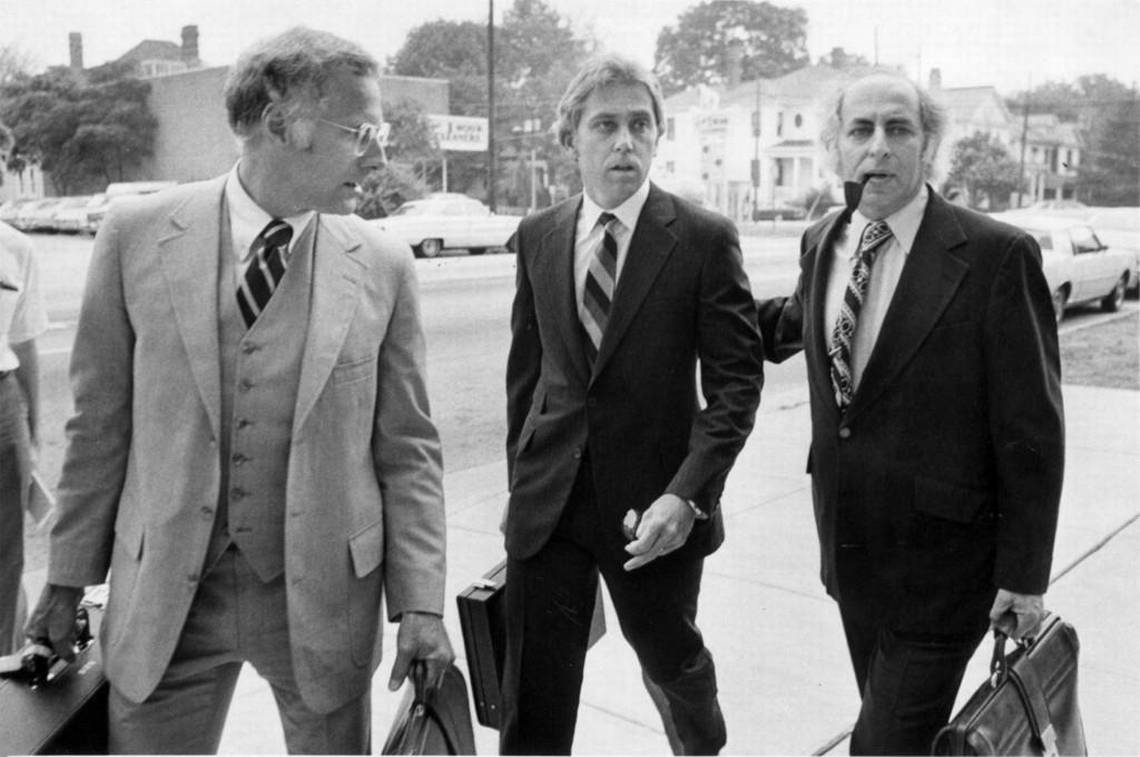
The Jeffrey MacDonald case is an interesting reference case to the Chris Watts case. MacDonald, from Fort Bragg, North Carolina, was convicted in 1979 of murdering his pregnant wife and two daughters in February 1970. The decade between the murders and the arrest, trial, conviction and incarceration provides a theoretical premise for a man who – at least temporarily – got away with murder.
MacDonald’s version of events turned out to be a whopper, as the clip with Larry King below illustrates. The important thing is MacDonald [a medical doctor] thought it was believable and credible, which is why he thought he would get away with what he did.
And this idea was part of the psychological ether floating around Fort Bragg in the early 80’s. Chris Watts was born into that ether on May 16, 1985. The distance between the Watts home in Spring Lake and Fort Bragg is less than 12 miles.
When military police officer Ken Mica arrived at Jeffrey MacDonald’s Fort Bragg, North Carolina apartment on Feb. 17, 1970, he saw MacDonald in the master bedroom, lying on his stomach next to his bloodied wife, Colette.
“I see he’s still alive and I lean down next to him and say, ‘Who did this?’ ” Mica tells PEOPLE. “And he starts describing three guys and a woman.”
The woman he described — long blonde hair or wig, a floppy hat and knee-high boots — resembled a woman Mica had passed on the way to the apartment belonging to MacDonald, a Green Beret surgeon. Mica says it was unusual to see a woman alone at that hour at Fort Bragg.
He told his lieutenant to send a police car, but no car was ever sent.
During the first day of the trial, Dupree allowed the prosecution to admit into evidence the 1970 copy of Esquire magazine, found in the MacDonald house, part of which contained the lengthy article about the Manson Family murders of August 1969. Prosecutors James Blackburn and Brian Murtagh wanted to introduce the magazine and suggest that this is where MacDonald got the ideaof blaming a hippie gang for the murders.
“I knew that this was it. This was going to change my life. I was gonna be the mom [tears up]…the mom that I wanted to be for my little one. I was gonna be the wife that I wanted to be for my husband. And I was gonna love me back. I was gonna have Cristina back. And that was [breathless]…that’s what I love the most about the Thrive experience…is that I’m me.”
Can you make out what she says at the very end as her voice breaks?
In September 2017, following the ten year anniversary of Madeleine McCann’s disappeatance, Australia’s Sunrise show interviewed American criminal profiler Pat Brown. At about 4:44 in the segment, the female reporter notes:
“Well, uh…your views on this [Madeleine McCann]…uh…have been…almost…silenced. You haven’t been on American TV for seven years [Brown nods on the split screen]. The UK media won’t talk to you…[Brown: Correct]. You’re here on Australian TV…um, and as you say, your book was banned from Amazon. Um, what do you think it is particularly about your theories that are…um…not liked by American and British authorities…”
The segment, titled “Crime expert claims Maddie McCann died in her holiday apartment 5A” has been viewed over 1 million times, and received about 1700 comments on YouTube, which is clearly indicative of the level of public interest in this question, and arguably its newsworthiness to the public, if not to American and British media.
As a former mainstream media and magazine journalist, where it was my stock and trade to pitch stories and engage with newspapers and editors, I had a very personal and very direct experience with the media in the McCann case.
So I’m a little confused. Who is getting thrown under the bus here? Is it the journos trying to report on a counter-narrative [the flip side of the narrative coin to the McCann’s version of events] which incidentally is also the “disgraced” lead detective’s scenio [he’s also been blocked, banned, sued etc], or are the McCanns being unfairly victimised by the media? Which is it?
If the media are so crooked and willing to throw the McCanns under the bus at the drop of a hat [as portrayed in Netflix docuseries The Disappearance of Madeleine McCann], why didn’t any British publication mention the series I wrote on the case – ever?
On the ten year anniversary, DOUBTand DOUBT IIconsistently outsold Kate McCann’s book, and DOUBT remained the #2 Amazon Bestseller on the Amazon.co.uk True Crime charts for days on end when coverage of the McCann case was at a peak.
Right now [March 25th, 2019] DOUBT is #9 on the same Bestseller list currently [just three spots behind Kate McCann’s book]. But not a single British reporter has ever contacted me and not a single article or reference to my book has appeared, even in articles dealing with all the books written on the McCann case, and believe me I checked.
Even more obvious in its absence from this category is the lead detective Goncalo Amaral’s book Truth of the Lie. In fact if you search for Amaral’s book on Amazon it’s only available in Portuguese.
From my side, the lack of engagement from the media isn’t sour grapes [well, LOL, maybe a little], but the broader point is there seems to be more of an agenda of the media towing the McCann line [perhaps for fear of being sued if they don’t] than of anti-McCann propaganda in the mainstream media.
But the way Netflix portrays it, the media coverage of the McCann case was and still is evil, biased, unfair and dishonest, and reporters inexplicably had and still have an axe to grind with the McCanns.
Fact is it was open season on the McCanns in the media for a very short window of time, and one could argue that the negative coverage following the cadaver alerts and the DNA narrative didn’t emerge in a vacuum.
I’ve worked in a newsroom in a major media house. Before I worked side-by-side with teams of editors, reporters, multimedia crews and sub-editors, I suspected there might be agendas and protocols and political and corporate arrangements running the show at newspapers as a matter of course. Sometimes there are. In some cases there are. But the media on the average day in terms of its basic coverage and general mandate is also a very dumb machine that simply does as it’s told.
Get the story. Tell the story as you see it.
Someone important says something, the media reports on it. Someone else important responds to it, the media reports on that. It’s often that simple.
The media’s strong point isn’t analysis or interpretation. If the media inveigles itself in these areas, especially when it comes to legal matters, it exposes its big fat cash cow underbelly to litigation. It would prefer not to if it can get away with it. It prefers to play dumber than it really is and instead panders to its audience and stakeholders.
Personally I find this attitude patronizing and cynical, but then patronizing isn’t necessary a bad word when you’re the one profiting out of the process. And some media coverage is neither here nor there, it’s simply a reflection of public sentiment. The media works as a sort of marketing machine, gauging public demand but also attempting to shape, influence and shift it. The media recycles what it’s told and it feeds the monster [us], tries to keep the monster full and satiated while trying to keep itself in the black. The media also has budgets, revenues and targets.
In this sense the media acts like both a barometer and a mirror, and sometimes what it reveals [us] is a salivating, greedy, addicted and oftentimes deeply ignorant flock of sheep. We too tend to believe what we’re told as an extension of the media doing the same thing.
Many journalists, including those writing about true crime, aren’t paid or even asked to think about it. They’re not required to prognosticate on the guilt or innocence of a particular character, in fact if anything they’re required not to. They’re told to record, report and repeat what others say, and often that’s all they do. So media coverage is by definition limited in its investigative scope.
When I researched the DOUBTtrilogy two years ago in 2017, I found 90% of the contemporary media coverage supportive of the both the McCanns and the “Madeleine is alive and missing” myth. The only exceptions to the media masturbating the pedophile narrative [apologies for the metaphor, but it’s an objectionable and bogus narrative to begin with], I found, were in the odd story by Australia’s Mark Saunokonoko and Natasha Donn’s reporting for the Portugal Resident.
In other words, if you wanted to find a counter-narrative to the reigning pro McCann Apologia, you wouldn’t find it in Britain or America. You had to go to the ends of the Earth – New Zealand, Australia and an obscure little English periodical in Portugal – to find it. Is that fair? Is that balanced? Is that ethical? Is this free speech? Is it defensible from the perspective of a free press?
More commonly you’ll find the British tabloids coming up with puff pieces like this:
If you are long familiar with the McCann case but don’t understand how propaganda works, the Netflix documentary is a shining example of how media can cleverly dupe the public. #mccann
I made a few forays to get publicity for my book and even those journalists that seemed more inclined towards Madeleine no longer being alive [named above] apparently didn’t feel my research was worth their time. That’s their right. But that’s editorial independence for you.
One journalist that I spent a lot of time – hours in fact – talking to and sharing my research was Mark Saunokonoko. [Listen to one of our conversations here]. I’ll give you a Noddy badge if you find Saunokonoko referring to me anywhere, once, ever. Saunokonoko has now produced a very popular and well-produced podcast series in which he quotes American author and criminal profiler Pat Brown at length.
The #Netflix documentary was an exercise in completely exonerating the McCanns and “disproving” any evidence indicating their possible guilt. Smithman was hardly even addressed. Total propaganda. #mccann
The point is the media isn’t lynching the McCanns, and for the most part my impression is that the media today seem to beating the drum and playing the tune of the McCanns whenever they make a peep.
In contrast the coverage of Amaral is typically less flattering. A case in point is the media attacking Amaral for making money out of selling his book [a book that is virtually invisible to the entire English-speaking world]. Bear in mind Amaral is unemployed and lost his job and income as a result of investigating the McCann case.
In the past, there have been some ugly skirmishes between the McCanns, the media, trolls and even Pat Brown, which I will cover in a post specifically dedicated to that subject.
Fortunately the court of public opinion is vast, and thanks to the democratisation of information, it’s becoming even more vast. As such, I for one as a former journalist don’t actually need the media or experts to endorse me or my work. I simply need my readers to trust me, to purchase my work and to keep purchasing it, and to do that I have to be a reliable, trustworthy, consistent and honest source, and one with no agenda.
I have no affiliation, no horse in the race other than to address and focus on the facts such as they are. And to some I execute that mandate, some might say quite well. If it’s good enough for them, it’s good enough for me, all this in spite of the media’s thumbs up for some while thumbing their noses at others.
Although the McCanns have washed their hands in public of the Netflix documentary that’s all about them, their struggles, and the search for their daughter, they do feature prominently in every episode.
That’s odd because the eight-part docuseries does the McCanns [and their version of events] many favours, not to mention the timing of it. The timing of the docuseries – from a PR perspective – is perfect.
So maybe we should mention the timing and one other thing – the money and potential fortunes – that’s ebbing and potentially flowing around the McCanns and the McCann case as of right now.
In terms of timing, the European Court of Human rights is about to rule, about to pronounce a verdict now, at the end of an eight-year legal slugmatch between the McCanns and their arch nemsis. The Portuguese detective that initially led the investigation features prominently in the Netflix documentary, although much of what he says is juxtaposed with others casting doubt or disputing his version of events.
Goncalo Amaral did the unthinkable in this story – he had the temerity to suspect both parents of complicity in covering up whatever happened to the doctors’ daughter.
Amaral was fired in October 2007 just five months into the investigation, and only one month after the McCanns were named official suspects in a highly controversial shift. This also caused the media coverage to change dramatically in tone from sympathetic to suspicious.
In any event, the timing of the Netflix docuseries coming out now is interesting, if nothing else.
The docuseries does a brilliant job of besmirching Amaral’s reputation as a possibly corrupt cop and potentially compromised individual.
If the series was as unbiased as it purports to be, it would have also investigatedJulian Peribanez, the former Metodo 3 investigator hired by the McCanns with the same meticulous thoroughness. It seems a little tricksy to have the McCanns’ detective narrate large fractions of the documentary where he openly criticises, accuses and undermines his opposition in the case.
In many of the slick true crime documentaries, the devil is in the details, not in terms of factors or evidence, but how the audience is influenced. Amaral is invariably interviewed in the same dour, claustrophobic setting.
The McCann’s PR person who also does plenty of narrating here, is shown in a lofty office which conveys a sense of professionalism and authority. Peribanez, Amaral’s counterpart , also appears in a professional setting, and then occasionally he is depicted “on the job” as it were, the crack detective in a fancy car basically role-playing the Spanish version of Magnum P.I.
Along with his boss, Francisco Marco and other Metodo 3 staff, he got into big trouble inearly2013. He and a number of other Metodo 3 staff were revealed to have been behind the illegal recording of conversations between high-level Spanish politicians in a Barcelona restaurant. Peribanez was discovered to have been involved and arrested. However, unlike his boss Marco, Peribanez rapidly admitted his guilt, confessed all to the police, and may have ended up assisting the police with their enquiries.
In 2014, it was announced that he had become a ‘poacher turned gamekeeper’ by publishing, jointly with the former head of Metodo 3 in Madrid, Antonia Tamarit, a book blowing the lid on corruption in Portugal but also, more specifically, the cess-pit of dark, nefarious and illegal activities carried out by Metodo 3. By this time, many of the top Metodo 3 staff had been arrested or imprisoned over the illegal recording of conversations at a Barcelona restaurant, and Metodo 3 had gone into liquidation.
So, in a classic case of ‘thieves falling out’, Peribanez and Tamarit decided to wrote a ‘tell-all’ book exposing the corrupt and criminal activities they had themselves been engaged in…
That’s more than the budget – almost twice the budget – of the entire search for Madeleine McCann by the authorities over the span of twelve years, the most expensive missing person’s search in history.
If we add the cost of the documentary to the cost of the search we’re in the region of £32 million spent on “the disappearance and search for Madeleine McCann.”
That’s a shitload of money based on a rather glaring assumption, that Madeleine McCann is alive and went missing to begin with.
Kandohla notes in her puff piece that the Netflix series was “commissioned in 2017” and conflates the commissioning of the series with “the explosion of the true crime genre.” In other words she’s suggesting the Netflix documentary was commissioned to make a mint out of the true crime genre, but she neglects to provide specifics on who commissioned it.
By mentioning the two documentaries in the same sentence, she also effectively compares The Disappearance of Madeleine McCann to Making A Murderer – the latter not necessarily a paragon of true crime documentary investigation in terms of accuracy or neutrality either.
Does anyone seriously think the filmmakers are going to make a profit on a budget of £20 fucking million for a documentary? The answer to that probably depends on who the filmmakers [and backers] are.
In Steven Avery’s case, all the Making A Murderer documentaries ultimately bore fruit, didn’t they? In February 2019 it was announced Avery had “won” the right to an appeal. You could say that, but you could also argue his PR had triumphed eventually. It’s not the first time that’s happened either. The Paradise Lost trilogy of documentaries also led to the release of the three men accused of murdering three boys in West Memphis [the West Memphis Three].
PR also played a huge role in the “acquittal” of Amanda Knox. Her father Curt once confided that his best move was to hire a PR guru within days of his daughter’s arrest. PR can and does influence legal narratives.
Was catching the commercial true crime wave really the only objective in making the 8-part series? Because the timing is very interesting. On January 31st, 2017 the Guardian reported on the first major legal setback the McCanns suffered in ten years.
So we see in 2017, the same year the legal tide turned against the McCanns, the 8-part documentary was commissioned. It was a major PR coup for them if the commissioning of the documentary with an enormous budget which just happened to support their own “pedophile abduction” theory to a “T”, happened coincidentally. But was it? Was this pure happenstance?
While Amaral’s libel damages as they stand now [£29 000] are fiddlesticks, barely a tenth of what the McCanns sued him for, it’s possible if the McCanns lose their final appeal to the European Court of Human Rights, the floodgates will open, clearing the way not only for Amaral to launch countersuits but potentially also many new media that the McCanns have sued for the years for defamation. Even if this doesn’t happen, a verdict that goes against them at this stage could swim the pendulum of public and media sentiment against them.
Interestingly in the Guardian article cited above the McCann’s refer to how much “the landscape has changed” in the eight years since they lodged their lawsuit against Amaral. Well, no landscape has changed more fundamentally than the media landscape, particularly with the advent of social media and more recently, streaming services like Netflix.
It’s clear Netflix has made available a documentary that is likely to influence people’s opinions on the McCanns, one way or the other. Does Netflix hold any responsibility in this regard? Should they? Should they be held to account for the veracity of the investigative content they provide to their subscribers especially as regard high-profile true crime?
In the past, Netflix has been beholden to the consumers of its product.
It remains to be seen whether true crime audiences will be aggravated or impressed, or simply too entertained to care about veracity or bias of the £20 fucking million documentary that the McCanns didn’t participate in [well, they appear in every episode], haven’t seen [apparently] and don’t support [ahem…].
If the the European Court rules against the McCanns, despite the influence or lack of the costly docuseries, will Amaral institute a colossal damages claim against them for systematic character assassination?
Whether he does or doesn’t, and whether the ruling goes for or against them, the McCanns are in an unusual position for the first time in many years. Instead of hope they have something to fear, and perhaps this time there is real reason to fear.
Some of you may or may not have seen this bodycam footage. The YouTuber speculating about “blood on the comforter” based on very fuzzy video isn’t helpful, and is [I believe] confirmation bias based on the scenario of the murder supposedly happening in the bed in the master bedroom.
The Yankee blanket question is more interesting. Was there one blanket or two? How many blankets in total did the kids have? Which blankets were missing? Which toys were missing? What did Watts dispose of at the dumpster on Black Mesa on his way home?
This bodycam footage also provides some of the best views of the downstairs television lounge, and the layout of the kids’ couches.
While researching the TWO FACE series there was very little concrete information on Shan’ann Watts. Not nothing, but very little, and because we still don’t have her financial records, it was hard to be sure one way or another about specifics regarding Shan’ann’s past.
Although I can’t find the actual quote, I seem to remember the District Attorney mentioning that neither Chris Watts nor Shan’ann Watts had a criminal history – in Colorado.
The one thing that stood out though was the Watts filing for bankruptcy in 2015. That doesn’t just happen. But the question remained, were both parties reckless and profligate, or was one worse than the other? And if so, how much worse? And in what way did this recklessness manifest? Just run-of-the-mill credit card debt, or something worse?
The final episode of the series kicks off by boomeranging back to Robert Murat, the first suspect the series itself fixed in its crosshairs. But in the final episode, Murat is no longer sketched as a prime candidate for the pedophile or trafficker moniker, now it’s poor Robert Murat.
The series seems to have covered a kind of full circle. Murat’s no longer portrayed as a suspect, but as a victim. it’s brilliant mindfuck for what’s to follow. Because this sympathetic twist is also an analogy for the McCanns themselves [nudge nudge, wink wink] as wholly innocent victims, isn’t it?
The docuseries strikes a much more sympathetic tone as it winds down now, basically taking the view that one of the major villains of the story – besides Amaral – is the media. See, the media have condemned and falsely judged Murat, and coincidentally the McCanns as well. See, the media have perpetrated a terrible injustice on an innocent man, just as they have on a wonderful, loving, innocent couple.
Really?
When the opening credits roll, Jim Gamble [we really need to talk about him at some point too, because he’s another Arch Apologist for the McCanns] does a handy voice-over about hope.
I want to address the aspect of hope that is such a crucial element of the McCann mythos, and the key dynamic driving their PR narrative. Essentially it is a narrative of hope.
In the past I’ve cited the idea that rebellions are built on hope, but I suspect it’s fallen on deaf ears. It sounds nice. It sounds catchy. But what does it mean? It really requires explication. I’ll do that at the end of this post, so put that thought in your back pocket for now [and give it a little tap]. We’ll attend to it later.
The main theme of episode eight is explicitly built around the notion of hope, and incidentally, it’s the subtext to the entire series as well, even though it pretends to be neutral, investigative, emergentivistic as opposed to reductionist.
Whether Madeleine was abducted by pedophiles, an orphanage, a travelling salesman, a gypsy, a gang of thieves or Santa Claus [don’t laugh, this was seriously presented as one of infinite suspects in the Ramsey case] any and every abduction scenario is a scenario that Madeleine is still alive, and thus this is “just” a missing person case. In other words, “there is still hope”.
As soon as the other narrative is acknowledged, then it’s not merely that Madeleine is dead, but almost automatic that her parents, and perhaps others are involved in some more or less nefarious plot. Are they? Could they be? Or is there some other explanation?
But consider how contrary the atavistic “fallen” notion is to the more progessive and thus sophisticated “hope” plot. And so, for as long as the abduction narrative is popular, and acceptable, and while the narrative that “there is no evidence that Madeleine is dead” continues to hold, the parents – and others – will remain above suspicion and implicitly beyond reproach. That’s not rocket science. We know this.
Episode eight is titled “Somebody knows”, which is to say a) somebody out there knows what happened to Madeleine [who is alive] and b) that somebody is not Kate or Gerry McCann or any of the Tapas 7. It’s not Goncalo Amaral either but some anonymous other person. And then there is c) if Madeleine herself is alive, apparently she doesn’t know who she is either and someone [the someone who knows] needs to tell her, or tell someone.
See, it’s a very hopeful episode. It’s positive. But is it realistic? It feels more than a tad reductionist, doesn’t it?If there’s no evidence that Madeleine is dead, does that mean she’s alive? If no one has seen her for twelve years, does that mean she’s alive? What about twenty years?
At what point does the passage of time actually enter the equation [besides the other crime scene related data]? After fifty years? How about sixty? And how are these time scales related to other missing person cases? Do we normally consider someone alive when they disappear for thirty, fourty, fifty years? If the law decides on this aspect [and it does] what sort of legal narrative are we actually taking about then, if we say there is “no evidence” to say she’s dead? Is there any evidence to say she’s alive?
To the casual observer, and even the not-so-casual observer, the hope narrative is both compelling and convincing. There is even an official inquiry condemning adverse media coverage of the McCanns [notably the the British media] as unethical and poor journalism. Since the media have been accused of this before, it’s easy to imagine they crossed this line with the McCanns, and clearly they did. The question is, how egregious was the inaccuracy? Was it completely baseless or was it somewhat baseless? Or…something else?
What this comes down to, ultimately, is what is truth? And what is the truth in this case? In one sense there is the objective truth [which is in a sense unknowable], and then there is the legal truth [which is what society’s “official” position is on truth]. A useful way to illustrate how potentially irreconcilable objective and legal truth can be, take religious belief. Is it objectively true? Some science, if not most, will say no. Is it legally true? Well, it depends on which country you are. In Saudi Arabia some “beliefs” are legally enforceable but not necessarily legal, and certainly not elsewhere.
The fact is, the legal position of the McCann case is that Madeleine isn’t dead, or rather, there is no evidence to prove that she’s dead. We’ll leave the argument for the moment that there is no evidence proving she’s alive either. In this respect, any publication claiming as fact or as potentially factual that Madeline is dead runs foul of legal fact, but not necessarily of objective fact. Does that make sense? So from a legal perspective, certainly the media are constricted in making certain claims, even if certain circumstantial and other evidence supports their claims.
And publishing Kate’s diary, apparently without her permission, does look bad in the context of this inquiry. On the other hand, Kate wrote a book in meticulous detail which was serialized in the papers, and her diary formed part of that narrative. So the notion that Kate’s interior world was violated feels a little less fraught than the way Kate frames. It may not be, but if we’re talking about the contents of a diary being published as a violation, and then one elects to do the same, well, isn’t one violating oneself?
It should also be noted that the diary was confiscated as evidence, and in many instances, diaries are used cynically by murder suspects to present a false narrative. Jodi Arias famously lied to her diary, which was discussed and analysed at length during her criminal trial. Amanda Knox kept a diary too which she quoted at length in her own self-justifying book.
Now if News of the World committed despicable act by “stealing” Kate’s diary, one could also argue that the same newspaper handed the McCanns a princely sum [£125,000] which went into the Find Madeleine Fund, which is to say, went by hook or by crook to the McCanns and the directors of the fund. The Sun serialised Kate’s book which was a major PR boost for the book, and deal probably worth millions. Let’s not forget it was the newspapers who also raised massive public awareness for the McCanns, including publicising the fundraising on their behalf [with their own readers], and making it known to the “abductor” that massive rewards were in the offing.
It seems impossible to imagine that if Madeleine was abducted, her abductor was not aware of the enormous reward offered for her safe return. Well, apparently it wasn’t enormous enough.
What you won’t find in the British press is what happened to the reward money [since no one came forward to claim it]. News of the World gave the McCanns £1.5 million reward money to the Find Madeleine Fund. Apparently when Gerry McCann was asked about whether he or the Fund had received the money, he referred to the questioner to ask the publisher, and suggested that the reward money wasn’t actual money but pledges.
Interestingly, in 2018 the McCanns tried to revive the Leveson inquiry, but this time the inquiry had other fish to fry. The Netflix documentary is silent on this recent failure, however.
Clearly the Leveson Inquiry needs to be seen in proper context given the myriad ways the McCanns benefited from British media coverage and publicity, and some may be so bold to say profited [or that their Fund made a colossal fortune out of it, at least for as long as the coverage was positive…which incidentally includes up to the present moment.] The point is, from a distance, a pair of well-to-do doctors appealing to the media for better treatment appears well-to-do in general, and to the casual observer, and the not-so-casual observer, this step appears to confirm their overall credibility in terms of this case.
But there’s more.
The McCanns took their cause even further and demanded British government intervention – to investigate the disappearance of their daughter. Now I know what you’re thinking. It stretches the credibility of a cover-up to breaking point – doesn’t it – to have the suspects demand an investigation into their case. It may seem that way, and clearly the folks in this particular true crime case are smarter than the average, but the Ramseys made similar appeals to powerful political figures. Ramsey himself ran for election twice. We must remember that these appeals for further investigation were conducted with the express proviso that the investigation be steered in a particular direction [away from the Ramseys as suspects].
It’s also vastly under-reported that Ramsey himself was affiliated with Lockheed Martin, in fact he was a vice president, and thus the death of a little girl actually presented a case for a potential risk or undermining of national security. I know that sounds outlandish, but only until one looks at the size of the MegaMachine that is Lockheed Martin, and its strategic importance to the security of the State it serves.
If one considers a criminal case which has the potential to affect diplomatic relations between two countries, then there are at least two possible scenarios. One scenario is that the suspects are guilty and because there is no prosecution or perception of justice, this can lead to enmity not only towards the suspects, but between the two nations.
In the McCanns case Portugal resented the way it was being depicted in the media, and referred to the British media and the British police treating it like it might a colonial power. This was clearly neither good PR nor politically expedient at a time when Britain wanted to – sort of – and Portugal wanted them – sort of – to belong to the European Union. The solution to problem – certainly one solution – was to make the case go away. By giving the public what they wanted [which was Madeleine to be alive, and the McCanns to be innocent] one could theoretically diffuse a political sensitive time-bomb. And the man the British government appointed to make sure the McCann case went where it needed to go was a man with the appropriately titled surname Gamble.
Gamble happens to be one of the primary narrators of the Netflix docuseries. He’s the man tasked by the British government with “sorting out” the McCann case. And Gamble has elected to sort out the case by publicly putting his weight behind. And he’s very public. He’s very much in the media and in documentaries.
Another prominent narrator is Kelvin MacKenzie, an editor of The Sun who – in episode eight – reveals that “not for a single second” did he believe the McCanns “have ever had anything to do with” Madeleine McCann’s disappearance. He has no doubt the McCanns are innocent. Well why not say so right in the beginning, sir? And why is an editor of The Sun between 1981 and 1994, thirteen years before the publicity of the case started, being asked to share his opinion on how the media treated them?
Well, so much for political expedience, and politically inexpedient court cases. Ten years later Brexit is happening anyway.
The best way to make a criminal case go away is to make sure it never goes to trial. But they didn’t count on the lead detective writing a book, or being sued, or him countersueing and appealing. That has been a long process and hasn’t helped the cause of the McCanns, the Metropolitan police, the British media or the British government. Or even the Portuguese government.
There is another half-hour of analysis to get through in the final episode of the series, but this blog is getting book chapter length and I see it’s 01:37. So let’s wrap up.
I mentioned early on in this post about the idea that rebellions are built with hope, and I said to put that idea in the back pocket. Let’s look at it now.
The idea of a rebellion built on hope is perfectly appropriate to the McCann case, at least in my view. The rebellion is arguably a rebellion against fear [fear of death] which is in some ways admirable, positive and constructive. But one might also argue that this rebellion isn’t just a touchy feely belief, but that in spite of claims of “no evidence” that Madeleine is dead, actually it looks like there might be some evidence. If it’s stronger than that, than the rebellion isn’t just against fear, it’s potentially against common sense, against reality, even perhaps against a legal system. We know the case is being debated and evaluated at the European Court of Human Rights. That court will decide whether the notion that Madeleine McCann is dead or alive – either way – is frivolous. It’s interesting because now Britain as a member of the European Union has sort of fallen out of favour with the EU, and not due to any fault of the EU.
What we can also say is that plenty of pageantry surrounds the McCann case. It’s not simply a case where we see investigations and police searches. We also see the couple meeting the Pope and releasing balloons, and suing people. A lot of people.
We see book deals, book launches, color coded wrist bands, hundreds of exclusive interviews [invariably written by the same journalists], dozens of documentaries, innumerable anniversaries and celebrations [Madeleine’s birthday, commemorating her disappearance], and of course, the revolving door of PR personnel who plead the McCann’s case to a salivating press – who in turn regurgitate these statements almost verbatim. That kind of pageantry.
The pageantry isn’t a foreign concept to Britain. The notion of Royalty in the modern era, and the royal family is fairly idiosyncratic to Britain, and arguably the most British aspect of the nation. One could also say that the pageantry of the British Royal family is more public and more publicised than royalty in any other country bar none. So let’s not kid ourselves when we say pageantry can be a very popular, powerful and profitable tactic.
But how much of this pageantry is really just a rebellion against a more pragmatic and realistic approach. Pageantry is bright, colourful but above all hopeful.
A final word on misleading media coverage – or at least what I thought was misleading – published in The Sun. This graphic. Notice anything wrong with it?
The graphic shows where the “last photo” of Madeleine McCann was taken. This photo is almost certainly fake, and appears to be doctored, its metadata altered so that the photo is dated May 3rd.
The indicator for where the Tapas Bar is on the graphic [right below the McCanns’ apartment] is misleading and incorrect. The Tapas Bar is way to the left, closer to the centre of the image.
In the next frame, the dogs didn’t alert to the sofa, they alerted to blood and cadaver evidence on the floor and walls behind the sofa.
Kate and Gerry’s beds were two single beds pushed together, but the graphic doesn’t indicate that both beds were pushed a long way away from the wardrobe, far enough to fit in the cots of the twins.
The same image makes no mention of cadaver traces found in the McCanns cupboard, nor of those found outside in the garden below the balcony.
The graphic suggests the door to the parking lot is the door to the patio. This is simply incorrect. The patio is on the other side, where the sliding doors are.
The way the door opens in the middle graphic and the bottom graphic is wrong. In fact it opened the other way, so that when one peered inside the first thing one would see would be Madeleine’s bed. An innocent mistake by the animator/illustrator, or deliberately misleading?
The graphic highlights the window and shutters as “the main source of the investigation” whatever that means. In fact Kate McCann’s fingerprint was found on the shutter, and Amaral didn’t believe an abductor would break in through an open, unlocked door, only to leave through an exposed window exit that would rattle loudly when opened. Why not simply leave the way he had entered?
In bold text The Sun emphasises:
KATE ENTERED THE BEDROOM TO DISCOVER THE WINDOW OPEN AND MADELEINE MISSING.
The perspective of both illustrations at the bottom emphasises the window. The bottom-most graphic actually views the apartment from the perspective of the wide open window, not the perspective of the door.
It’s this sort of chronically misinformed coverage that is either spineless, pandering journalism or ignorant to the extreme. One thing it clearly is is the same thing that all tabloid newspapers are – pageantry.
A final point to make is this photo that appears in the final episode. Why has it been artificially enhanced?
Perhaps because the unedited photo is so grim and gloomy. The child looks completely isolated in the original photo.
Which is why the photo is edited to make her seem less on her own, and her surroundings brighter, and sunnier.
As with so many things in the McCanns case, this simple image – when one looks closer – appears to be fake. Is it pageantry or isn’t it, and if it is, what more than this?
In POST TRUTH, the 100th True Crime Rocket Science [TCRS] title, the world’s most prolific true crime author Nick van der Leek demonstrates how much we still don’t know in the Watts case. In the final chapter of the SILVER FOX trilogy the author provides a sly twist in a tale that has spanned 12 TCRS books to date. The result may shock or leave you with even more questions.
SILVER FOX III available now in paperback!
“If you are at all curious about what really happened in the Watts case, then buy this book, buy every one he has written and you will get as close as humanly possible to understanding the killer and his victims.”- Kathleen Hewtson. Purchase the very highly rated and reviewed SILVER TRILOGY – POST TRUTH COMING SOON.
TCRS MERCH available now – just in time for Christmas!
Book 5 – ALL NEW! “I have thoroughly enjoyed this audiobook…” – Connie Lukens. Drilling Through Discovery Complete Audiobook
Read the entire 9-Part TWO FACE series, the most definitive book series covering the Chris Watts Case
Visit the TCRS Archive of 100 Books dealing with all the world’s most high-profile true crime cases.
Join the TCRS Community on Patreon for as little as $1 per month. Multiple daily posts, interesting discussions, amazing audiobooks narrated by the author, ongoing series and powerful, informative weekly podcasts.
Subscribe to the Growing TCRS YouTube Channel
Book 4 in the TWO FACE series, one of the best reviewed, is available now in paperback!
“Book 4 in the K9 series is a must read for those who enjoy well researched and detailed crime narratives. The author does a remarkable job of bringing to life the cold dark horror that is Chris Watts throughout the narrative but especially on the morning in the aftermath of the murders. Chris’s actions are connected by Nick van der Leek’s eloquent use of a timeline to reveal a motive.”


 Goncalo Amaral did the unthinkable in this story – he had the temerity to suspect both parents of complicity in covering up whatever happened to the doctors’ daughter.






Recent Comments