

True Crime Analysis, Breakthroughs, Insights & Discussions Hosted by Bestselling Author Nick van der Leek
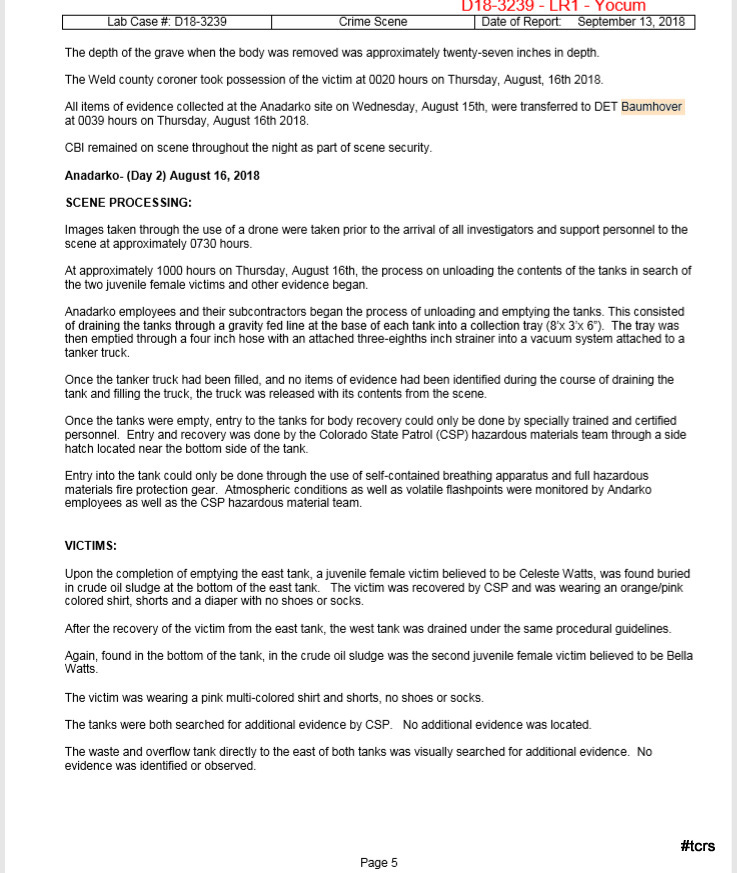
Do you see FBI Special Agent Grahm Coder’s name and signature?

A lot of mystery and intrigue surrounds the Watts family finances, particularly on Shan’ann’s side. Although we don’t know the numbers, Shan’ann’s Facebook provides an almost infinite portrait of Shan’ann’s work ethic, lifestyle choices and product choices.
Without knowing the numbers exactly, we can be pretty clear what was going on behind the scenes in the Watts family.
I expect this to be a controversial post, with many dismissing whatever is written here with the “Victim Blaming” label, simply because as far as the finances were concerned, Watts was clearly the true breadwinner of the couple.
There’s a caveat to this, but before dealing with that aspect, let’s examine a few undisputed facts, all of which are anchored in the legal realities of the Discovery Documents:


These are the facts, but the bottom line is the Watts couple were in serious financial difficulty by August 2018, and for the second time in three years. This time, the difficulties were compounded by a third pregnancy, an affair, and the imminent threat of the family losing their home because of a debt spiral they would not acknowledge, and this time, could not escape.

So how did this financial disaster double act actually happen?
Because of a kind of “tunnel vision” regarding the Watts case, many are disinclined to acknowledge any flaw or failure on Shan’ann’s part. It’s disrespectful to criticize her in any shape or form [so the argument goes] because she’d dead, didn’t deserve to die no matter what, and can’t defend herself from beyond the grave.
But the question here is what was the true state of the finances? There is none better than Shan’ann to tell us about this, and she does. She can; even from beyond the grave.
We have her own texts and behaviors to work from in the final days.

When Watts spent $62 at a restaurant on Saturday night, August 11, Shan’ann’s phone alerted to the purchase and Shan’ann freaked out. She went into emergency mode, battening down the hatches, Googling menus, checking prices, and giving her husband instructions to keep the receipt for the meal.  Although this was a symptom of Shan’ann checking on her husband’s fidelity [and her suspicions were valid] we shouldn’t miss the mechanism that this takes – the finances. Shan’ann’s surveillance of her husband is done via financial vigilance. And if this meticulous financial oversight of a restaurant bill [while she was on a trip in Arizona, also eating at restaurants and Thrivin’] wasn’t a sign to her friends and companions that the Watts family were stressed financially, what would be?
Nickole Atkinson was aware that Shan’ann was careful about expenditures, choosing cheaper restaurants, while at the same time, sending her children to a school Nickole herself considered unaffordable for Shan’ann.
We know that at the same time the girls were going to be back at $500-a-week Primrose school, Watts [not his wife, not him and Shan’ann, just him] was facing a mortgage payment of $1700 that he simply could not meet, and he was already three months behind.

Someone else’s debts are easily dismissed. It’s easy to treat someone else’s mortgage and credit card impairment as passé. When it’s yours, it’s less easy to be that laissez faire about it, isn’t it?
Now imagine you do care about your debt, and you do care about losing your house, and losing everything, but someone else is in control of your money [your salary, the bank account, even the actual state of your financial situation]. And no matter how much you try to address it, nothing changes. Someone else remains in control and the situation simply continues to unravel. Well, that was the situation in the Watts family.
In any scenario where a couple have no money and there is a pregnancy, there is an automatic crisis. We see it with teenagers and unplanned pregnancies all the time. The difference was that the financial side of Watts fairy tale appeared to be there when in reality, in 2018, it was little more than a facade. Now why might this be?
Shan’ann’s approach to the finances seemed to be not 100% grounded in reality, just as Thrive and MLMs in general are not 100% grounded in reality [to put it mildly].
Perhaps Shan’ann’s attachment to MLM had a lot to do with a delusion about the true state of her marriage and their finances. People who sell for a living, and marketers, are incentivized to make believers out of their buyers. To sell they must be confident and convincing, and the best way to do that is to believe their own bullshit. When it comes to MLM, this stereotype of brain addled huns drunk on the same Kool-Aid is so common it’s cliche.
But making the sale is one thing, believing you’re sitting on a pot of gold when it’s actually a pile of shit is another situation altogether. In the Watts household, it didn’t just happen. It took two-and-a-half years for the debt bubble to balloon into a debt mountain of steaming dung. Sometimes debt can be like a nightmare. Sometimes one’s own debts can just feel like someone else’s, or simply hypothetical, especially when one’s escaped or wriggled out of a tight financial impasse before.
Typically, phantom money exists around fake people.
In this fakery, both Watts and his wife appeared to be complicit. Neither really told their friends about their financial problems, and yet their friends and colleagues seemed to know there were financial problems regardless.
What their friends said:


In all the text messages during the weeks prior to the murders, the issue of financial strain seems to be the one thing Watts and his wife never brought up, and never argued about. Unless this aspect has been selectively excised from both their phones.
More likely though, neither were particularly focused on the finances until it was too late. Watts may or may not have been misled or kept in the dark about their money, something that may have been an error, a weakness, a misrepresentation or a manipulation [or a combination of all of these] from his wife.
There appears to be some evidence not only of financial mismanagement in Shan’ann’s past, but possible dishonesty and criminality.

The same can also be said about Watts, who, if Trent Bolte’s accusations are true, Watts was spending money on male hookers and buying him botox treatments. Even if Bolte’s allegations aren’t true, we know Watts was conducting an affair when – financially if not otherwise – he could least afford it.
Probably the best insight we get into the Watts finances is from a source almost everyone dismisses as either unreliable or just plain evil. Nichol Kessinger. By judging her in this manner, an entire line of evidence is simply lost. In terms of finances, and narcissism, Kessinger is one of very few characters in this true crime story that had no debt and wasn’t pitching herself across the suburbs and rooftops of social media.
From Kessinger we find:


In sum we can see that both Chris and Shan’ann Watts hid the true nature of their finances from the rest of the world. They both seemed to be actively hiding other things too, for various reasons [for him the affair, for her the Thriving fakery and the true nature of her marriage].
Isn’t it ironic that both were arguing about when to “reveal” the gender of the third baby at the time of the murders? Forget about the fact that it was about the baby, or the baby’s gender, it was a conflict about when to make known something…
If Shan’ann’s side of the income equation was shaky, and I believe it was, that doesn’t make her completely and utterly responsible for the financial mess they were in, but it sure did aggravate it. Unfortunately, because the Watts case never made it to trial, we’ll never know just how much “aggravation” Shan’ann’s MLM addiction caused the marriage, and sadly, millions of Americans caught up in MLM will have to learn their lessons firsthand – the hard way.
Ultimately, whether he was pushed, misinformed, stupid, or simply not paying attention, Watts was responsible for allowing things to get as out of hand – financially – as they got. Lest we forget, Watts was a participant in the Thrive thing as well, albeit a rather lackluster extra in his own Thrive spiel.
He ought to have taken control of the MLM train wreck sooner. He would have had he been more hands-on and informed about the practical financial realities they faced. Had he been more hands on he would have learned from the first financial disaster and not pursued a third pregnancy.
The purchase of the big house was the main millstone around their necks. Simultaneously, thanks to the health of the housing market, disposing of the house was their potential salvation. Watts may have felt justified in only saving himself financially, since Shan’ann couldn’t be saved [in his mind], but he conflated financial ruin and resurrection with murder and death.
While all of this is true, it should be noted that things spun out of control [financially] in the final few months before the murders. While Shan’ann was in North Carolina, Watts was falling in love. It’s possible the debt monster when it hit seemed to come out of left field.
An aspect almost everyone seems to have missed is that Kessinger likely made Watts not only aware of the true state of his deleterious financial situation, but pushed him to be responsive to it.
Neither saw it coming when the financial tsunami hit, but when it did, Watts panicked. He didn’t panic in a vacuum – probably he blamed Shan’ann [and possible the children too] for “ruining” his life. Financially, that is.


This book was just so incredibly well done! To anyone that is interested in this case, this is vital reading. It walks you through the interrogation from many different perspectives. I found myself, as I tend to do with Nick’s books, reflecting on this case and gaining incredible new insight into what, when, where, how, and most importantly, why. If there are questions as to why this book isn’t released in hardcopy form, it really isn’t meant to be. The links provided by the author, (peppered through the book) when clicked on, invoke stronger understanding. Nick has such a brilliant mind and was born to do this! I’m ready to go back and start reading the other books in the series for the second time. I just can’t get enough! I’m hooked!
Each day we’re getting to know the labyrinth that is the Watts crime scene more clearly, and in more detail. Each day we’re increasing our knowledge of known knowns, and known unknowns. It takes longer for the unknown unknowns to make themselves known. Sometimes we stumble upon these by sheer happenstance.
There is a place for intuition in true crime. There’s always a grey area where we can see something, or feel something, but we’re not sure what we’re seeing. True crime is filled with smoke and mirrors, but it’s important not to look for smoke where there is none. Rather, we want to try to make sure what we are seeing is actually there.
In the video below we see a collection of “omens”, from weather phenomena, to sinister dolls to injuries. The weather isn’t irrelevant in true crime. The fact that this crime took place at the height of summer, towards the end of summer, late at night/early morning means something. It feels premeditated but it looks last-minute in a sense too, doesn’t it?
The doll in pink clothing wrapped in a white plastic bag with an orange ribbon is perhaps easier to glimpse by watching the video. Dolls and toys also feature prominently in the JonBenet Ramsey and Madeleine McCann cases. What is the significance of this one – in the trash?


Beside the bin with the doll in the trash bag is something else that’s plain to see. It’s an orange container. It’s close to the door to the garage.


Permatex Fast Orange is a typical hand cleaner used by mechanics. Although not odorless, it is colorless, waterless and biodegradable. It doesn’t contain ammonia, which destroys DNA, but it does contain glycerin. Glycerin is a type of humectant – a substance that reduces a loss of water. So in terms of crime scene maintenance, this substance would likely not have been used inside the house, but may have been used to wash hands. Even then, ordinary soap and water would be more effective in destroying DNA.

https://youtu.be/bi_YxtLEgVw
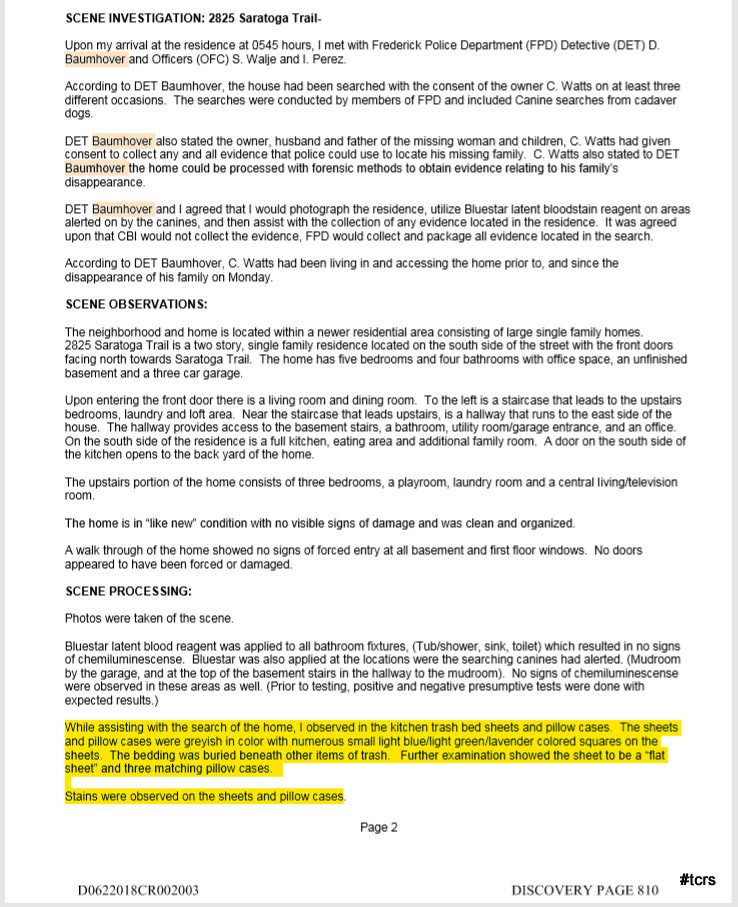
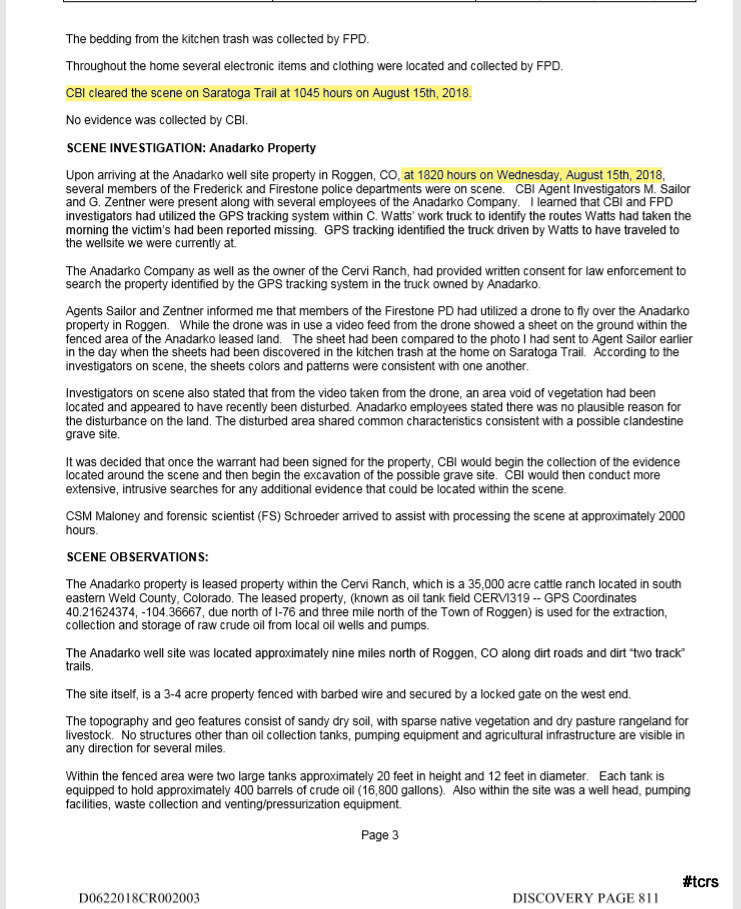
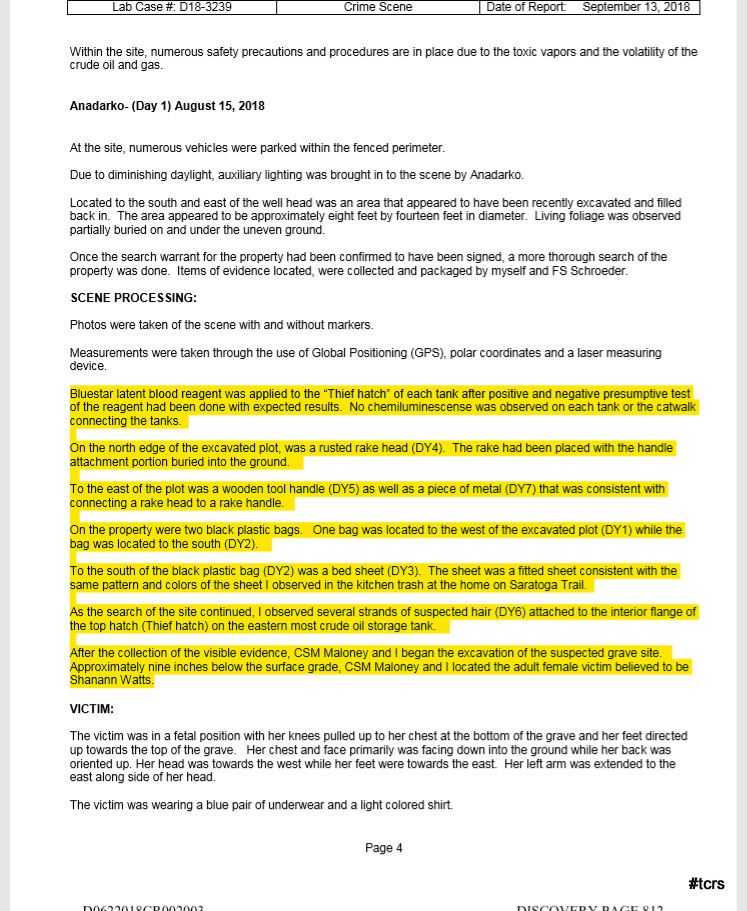
One possible explanation for the doll in the trash, like the sheets in the other trash bin, was the removal of reference evidence from the crime. Reference evidence isn’t direct evidence as much as it’s evidence that might cause one to ask relevant questions.
If one of the children typically slept with a doll, then where that doll was found [if not removed from the scene] may be where the child died. If so, removal of the doll from the scene would be insufficient because if it appeared somewhere else, then that might cause problems too. So the doll needs to be discarded entirely so that that line of inquiry isn’t triggered.
As mentioned above, the same psychology appears to be in operation in terms of the sheets and pillow cases. The sheets and pillow cases aren’t removed because they contain evidence, but because they may trigger questions that may lead to other evidence. In sum then, the removal of certain reference evidence is to create smoke and mirrors. You’re seeing something, but you don’t know what you’re not seeing [the unknown unknowns]. Once you see, for example, the doll or the sheets in the trash, you have the beginnings of a known unknown.


Okay there is something here, but what does it mean?
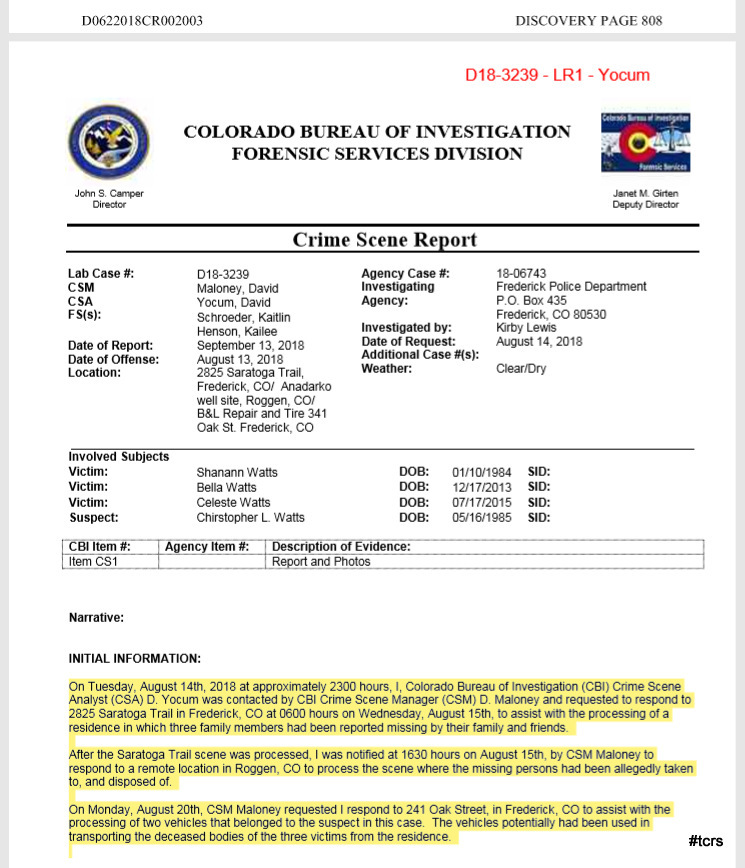
In the kitchen trash, the bag itself is approximately the same color as the sheets that were placed in them, presumably under a layer of trash that concealed them from a cursory inspection. Was that intentional?
The color of the bag seems to be coincidental [based on the screengrab below from one of Shan’ann’s Live videos].

The debris scattered on top of the sheets was obviously deliberate. But was it meant to conceal just the sheets, or something else too?

There are two Thrive sachets at the bottom of the trash bag, suggesting the girls may have had something to eat or drink before they went to bed. If so, what does that mean…?


On the night of August 14, CBI agent Greg Zentner was dispatched to Boulder to interview the most crucial witness in the Watts case. The transcript below is an excerpt from a 72 page document spanning 3223 lines of text.

CrimeRocket is the first to reproduce and analyze this critical transcript in-depth. The entire transcript has been broken down into 15 sections.
The fifteenth part involves the winding down of the interview. Nickole refers to her friends pressuring her for information, and her feelings of reluctance.


The audio for the above transcript is available here.
On the night of August 14, CBI agent Greg Zentner was dispatched to Boulder to interview the most crucial witness in the Watts case. The transcript below is an excerpt from a 72 page document spanning 3223 lines of text.
CrimeRocket is the first to reproduce and analyze this critical transcript in-depth. The entire transcript has been broken down into 15 sections.
The fourteenth part includes:


The audio for the above transcript is available here.









© 2025 TRUE CRIME ROCKET SCIENCE
Theme by Anders Noren — Up ↑


Recent Comments